
Progressive Choroid Plexus Enlargement: A Window into Multiple Sclerosis Evolution
Using advanced longitudinal imaging, we investigated how the choroid plexus – a critical gateway between the immune system and brain – changes over time in MS patients, revealing new insights into disease progression and brain tissue damage.
Key Findings:
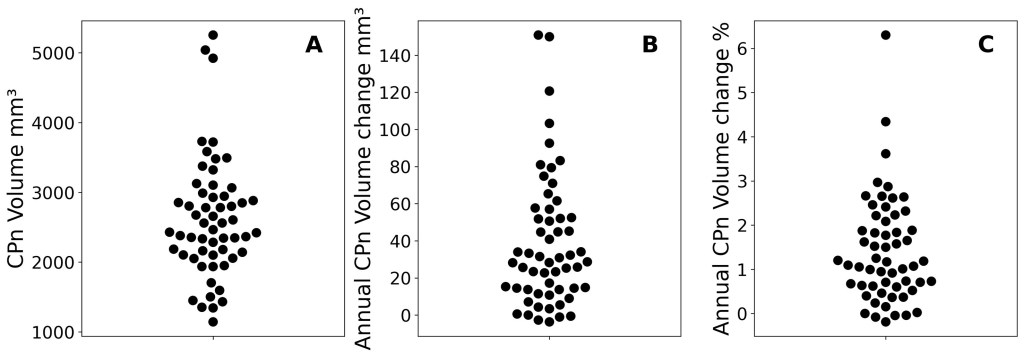
- Consistent Growth: The choroid plexus shows progressive enlargement of about 1.4% annually in MS patients, though individual rates vary considerably (from -0.2% to 6.3%)
- Tissue Damage Link: Enlargement strongly correlates with both expansion of chronic MS lesions and accelerated brain tissue loss, particularly in areas near the brain’s ventricles
- Selective Impact: While the changes affect both white and gray matter, deep brain structures show stronger effects than cortical regions, suggesting a distinct pattern of tissue damage

Clinical Implications:
- The progressive enlargement of the choroid plexus may serve as a measurable indicator of ongoing inflammatory processes in MS
- The strong correlation with brain tissue loss, particularly in periventricular regions, suggests choroid plexus changes could help predict disease progression
- The differing impact on deep versus cortical brain regions provides new insights into how MS affects different brain compartments
Why It Matters:
This longitudinal study reveals for the first time how choroid plexus enlargement tracks with key measures of MS progression. Rather than being a static change, the continuous growth of this structure appears tightly linked to ongoing inflammatory processes and tissue damage. This insight opens new possibilities for monitoring disease activity and potentially identifying patients at higher risk of progression, while also suggesting the choroid plexus itself might be a meaningful therapeutic target in MS treatment.
 MS Lesion Analytics