
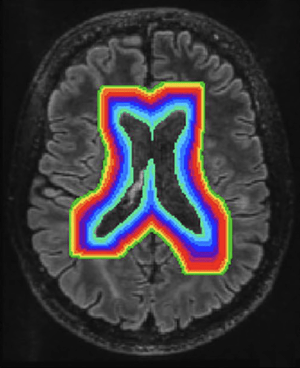
MS lesions demonstrate distinct patterns of expansion based on their location within the brain, particularly in relation to the cerebrospinal fluid (CSF).
Periventricular Gradient
Lesion expansion follows a clear gradient pattern related to CSF proximity:
- Expansion rates are highest near ventricles
- Each millimeter away from ventricles reduces expansion rate by 1.5%
- 91% of expanding lesion volume occurs within first 10mm of ventricles
Tissue Damage Patterns
The severity of tissue damage also follows this gradient:
- Higher mean diffusivity (MD) in lesions closer to CSF
- More pronounced T1 hypointensity near ventricles
- Progressive tissue damage accumulates faster in periventricular regions
Clinical Significance
This spatial pattern has important implications:
- Helps explain heterogeneity in lesion expansion between patients
- Suggests CSF-mediated factors influence disease progression
- May guide development of targeted therapies
- Provides new biomarkers for monitoring disease progression
Research Applications
Understanding these spatial patterns enables:
- Better prediction of lesion evolution
- More accurate assessment of treatment efficacy
- Improved patient stratification for clinical trials
- Development of location-specific therapeutic approaches
 MS Lesion Analytics